


San Blas vs. Guna Yala: Which Term is Correct?
San Blas or Guna Yala: Which Name is Correct for Panama’s Islands?
When exploring Panama’s Caribbean islands, you’ll encounter two names: San Blas and Guna Yala. Both refer to the same stunning archipelago of over 365 islands and cays. However, to understand the difference, we must look at the region’s history, culture, and political evolution.
The San Blas Islands are located along Panama’s Caribbean coast. Known for their clear waters, coral reefs, and untouched beaches, they attract travelers worldwide. But behind the breathtaking landscape is a deeper story of resilience, tradition, and identity. So, is it San Blas, or is it Guna Yala? Let’s explore the meaning behind these names and how they represent the spirit of the region and its people.

The Colonial Roots of San Blas
The name San Blas originates from Panama’s colonial era when Spanish explorers and missionaries sought to expand their influence across the Americas. In their mission to map and claim territories, they often renamed regions after Catholic saints. This is how the archipelago became known as San Blas, named after Saint Blasius. This was in line with the Spanish crown’s religious and administrative goals. For centuries, the name San Blas appeared on maps, navigation charts, and travel literature, symbolizing Spain’s lasting influence in the region.
However, this renaming was not just about labeling a blank spot on a map. Long before the Spanish arrived, the Guna people had already inhabited the archipelago. They had their own language, governance, and a deep cultural connection to the islands. To them, these islands were sacred, integral to their cosmology and daily life. The imposition of the name San Blas represented more than a simple name change—it aimed to erase the identity and heritage of the Guna people.
The Guna did not accept this lightly. Unlike many indigenous groups, they successfully maintained control over their lands and traditions. Their resistance to both Spanish and later Panamanian authorities showed their strong commitment to self-determination. Despite pressures to assimilate, the Guna held firm to their way of life. Meanwhile, the name San Blas persisted in official records and became synonymous with the region in popular culture.
Today, the dual naming of the archipelago—San Blas for outsiders and Guna Yala for the Guna people—tells a deeper story. It reflects resilience against imperial rule, the strength of cultural identity, and the ongoing acknowledgment of indigenous sovereignty.

The Emergence of Guna Yala
The Guna people originally lived in the northwest Antioquia region of Colombia and Panama’s Darien Province. However, conflicts with the Spanish Crown and other indigenous groups led them to migrate westward. Their journey eventually brought them to the islands of Guna Yala, where they founded a flourishing community.
In the mid-1800s, the Guna began relocating to islands near freshwater river mouths. This strategic decision protected them from diseases, snakes, and mosquitoes found on the mainland. The islands also provided better access to coastal trade routes, opening connections with different cultures and goods.
A turning point in Guna history came with the 1925 Guna Revolution. Facing attempts to suppress their customs and integrate them into mainstream society, the Guna led a successful revolt against the Panamanian government. This resulted in the creation of the Guna Yala comarca—an autonomous territory where the Guna retain control over their land, laws, and cultural traditions.
The name “Guna Yala,” which translates to “Land of the Guna” in their native language, marks a reclaiming of their identity and a rejection of colonial impositions. Officially adopted after their autonomy, the name reflects their deep connection to the land. Today, it is widely used in formal contexts, particularly in government and cultural discussions.
Beyond their political achievements, the Guna are celebrated for their vibrant culture. Their traditional molas, intricate textile arts, have gained global recognition. Their matrilineal society places women at the heart of community life, granting them significant authority and respect.

The Congreso General Guna
One of the defining features of Guna Yala is its governance system, known as the Congreso General Guna. This traditional council plays a central role in preserving community autonomy. It is composed mainly of respected elders, who guide decisions about social, cultural, and political matters. Leaders are chosen not by election, but based on community respect and deep knowledge of traditions. Moreover, this structure reflects long-standing Guna values and ensures decisions reflect collective interest.
The Congreso Guna also oversees law and order within the comarca. It regulates natural resource use and ensures the culture is preserved. In addition, it protects traditional knowledge by promoting generational transmission of customs and beliefs. This leadership has been essential in managing external influences, including the Panamanian state and tourism. As a result, the Guna maintain control over their future while staying true to their identity.

San Blas and Guna Yala: A Name with Two Realities
Although Guna Yala is the official name, “San Blas” remains widely used—especially in travel and tourism industries. Many visitors know the region as San Blas, a name rooted in colonial maps and old travel literature. This dual naming shows the intersection between indigenous identity and global tourism. One name highlights authenticity, the other international familiarity.
For the Guna, this isn’t necessarily a contradiction. Instead, it reflects the evolving nature of their living culture. They embrace autonomy and take pride in being the guardians of Guna Yala’s heritage, language, and land. At the same time, they understand tourism’s value and the visibility that the name San Blas offers in a global context. By balancing both names, the Guna preserve their traditions while welcoming modern opportunities.
Essential Facts About Guna Yala Culture and Region
A. Guna Yala Flag: Gunasuenamor – Gunabander

At the top sits a red stripe. In the middle, a broad yellow stripe stretches across. At the bottom, a deep green stripe grounds the design. In the center, two strong crossed arms hold a bow and an arrow. Surrounding this central image are eight stars.
- First, the red stripe stands for the blood of the Guna people. It honors all generations—past, present, and future.
- Next, the yellow stripe represents the sacredness of Mother Earth. The Guna are united with her and value life deeply.
- Meanwhile, the green stripe highlights the region’s natural resources. These resources are vital for daily life and survival in Guna Yala.
- At the heart, two crossed arms grip a bow and arrow. This image recalls the 1925 revolution led by Simral Colman and Nele Kantule.
- Finally, the eight stars symbolize Ibeler and his brothers. They continue to protect Guna Yala and guide its future leaders.
Source: Diccionario Escolar | Gunagaya
Side Note: You may be interested in our post about the alternative San Blas flag. Learn about its history, featuring a swastika with spiritual, ancestral significance, unrelated to Western conflicts.
B. The Language of Guna Yala
To begin with, the Guna people speak a unique language called Gunagaya—also known as Dulegaya or Dulegagga. It is not merely a dialect. Instead, it is a fully developed language with its own distinct grammar and structure. Although the written form stays consistent throughout the region, each community has a different way of speaking and reading it. This variation is similar to how Spanish differs in Mexico, Argentina, Cuba, and Panama.
Thanks to the dedication of language experts, Gunagaya continues to thrive. Their work helps preserve the language’s richness and ensures it will endure for generations to come.
Some Guna vocabulary:
- Aya | Ai: Friend, companion; acquaintance, ally.
- Baba | Babdummad: Great father, supreme being, creator of the universe alongside Nandummad.
- Dule: Person, individual; term used by the Guna people to refer to themselves.
- Gwendi / ¡Gwendina!: Of course! That’s right!
- Ilesgagga | ilesgaya: English language.
- Mer / Melle: No; negation particle.
- Mergi: American
- Nana | Nandummad: Great mother, supreme being, creator of all that is created alongside Baba.
- Neg / Nega: House, dwelling, home; nature; cosmos; ecosystem.
- Ua: Fish.
- Wago: The first creature of Baba and Nana on Earth, father of trees and plants.
- Wilubbira / Wilubbiragwa: Equal; fair, upright; equitable.
Source: Diccionario Escolar | Gunagaya
Preserving the Legacy
Whether called San Blas or Guna Yala, this archipelago stands as a symbol of resilience and beauty. It reflects both the strength of its people and the richness of its environment. Visitors are attracted not only by the stunning landscapes but also by the chance to experience a way of life rooted in tradition.
The Guna people’s commitment to sustainability is evident in their eco-friendly tourism practices. They also show great respect for their natural resources. As a result, this paradise remains unspoiled, preserving its beauty for generations to come.

As you embark on your luxury catamaran voyage to this captivating destination, pause to reflect on the stories behind its names. Whether you’re discovering vibrant reefs, unwinding on peaceful beaches, or immersing yourself in Guna culture, keep in mind that every corner of Guna Yala—San Blas—is rich with history and significance, offering much more than a typical tropical getaway.
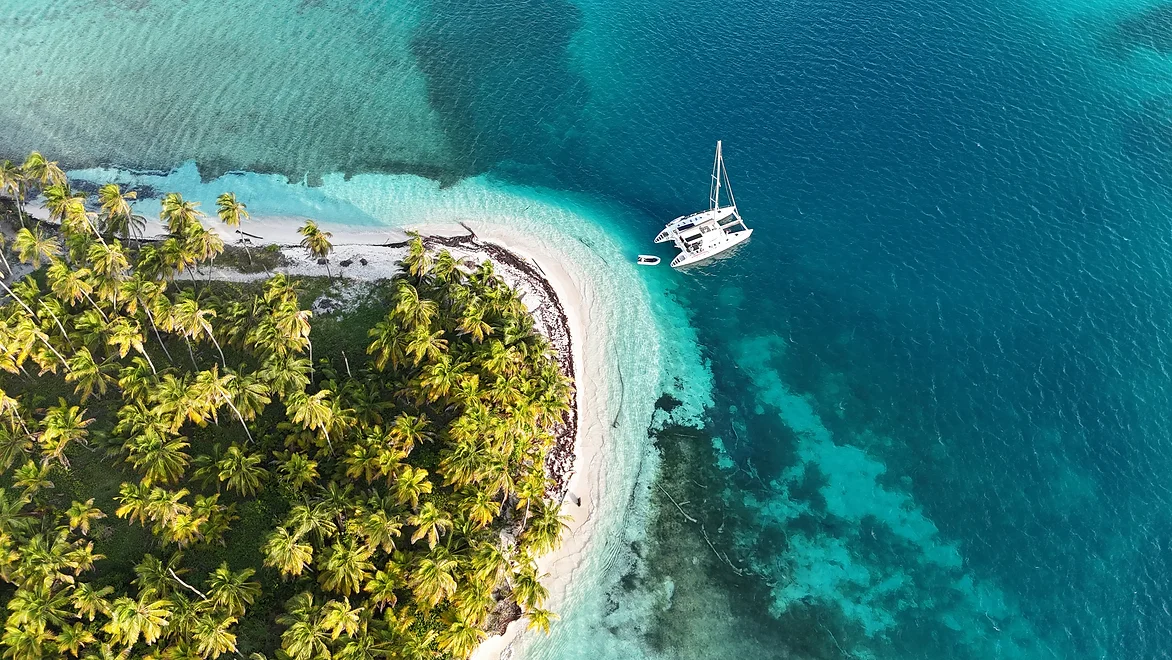
The crystal-clear waters and untouched landscapes create an ideal setting for your adventure, enhancing the experience with luxury and tranquility. Explore our curated itineraries to find the perfect fit for your desires, offering you a chance to delve deeply into this enchanting, ancestral land.